


Your shopping cart is empty!
Tomato "Black Ethiopian"
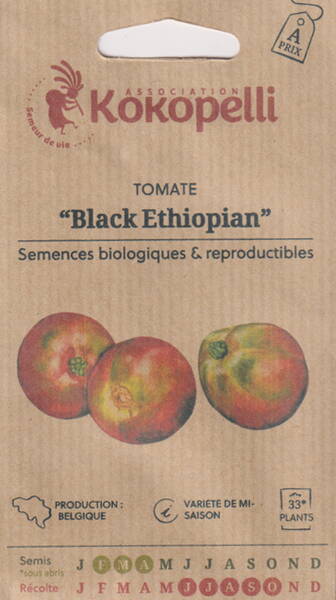
Eco seeds
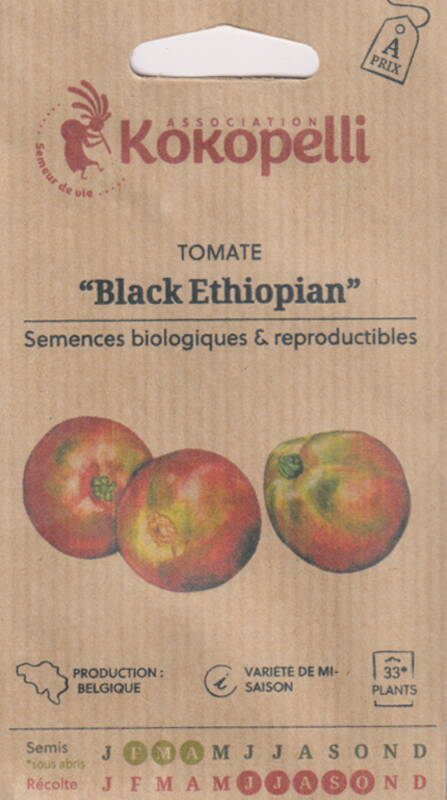
Tomato "Black Ethiopian".
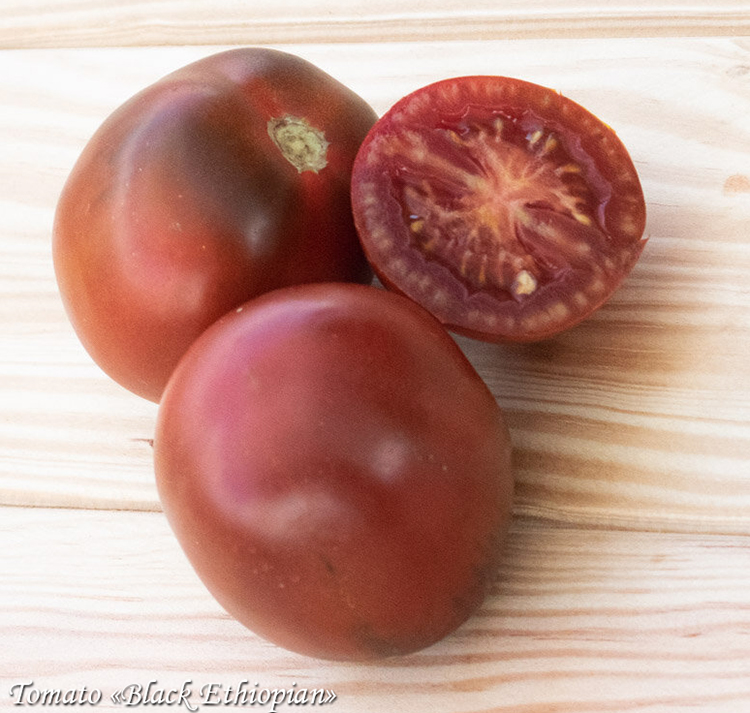
This renowned heirloom variety, originating from Soviet Ukraine, yields beautiful trusses of about 6 very dark, red-brown (mahogany) fruits weighing between 50 and 150 g. Their elongated, round shape resembles a large plum, while the dense flesh boasts a sweet, slightly tart, and very rich fruity flavor.
Maturity: mid-season.
Weight: 50–150 g.
Texture: meaty.
Growth Type: indeterminate.
Plant Height: 160 cm.
Foliage: regular.
This renowned heirloom variety, originating from Soviet Ukraine, yields beautiful trusses of about 6 very dark, red-brown (mahogany) fruits weighing between 50 and 150 g. Their elongated, round shape resembles a large plum, while the dense flesh boasts a sweet, slightly tart, and very rich fruity flavor.
Maturity: mid-season.
Weight: 50–150 g.
Texture: meaty.
Growth Type: indeterminate.
Plant Height: 160 cm.
Foliage: regular.
* Many amateur gardeners prefer to use only organic fertilizers, believing that this will help them get rid of nitrates. Nothing of the sort: they have always been and will always be there! Both in the soil and in the plants. There is no escaping this natural process.
Nitrates are salts of nitric acid. They are highly soluble in water, migrate easily, and can accumulate in significant quantities in the root zone of the soil and, consequently, in plants. Salts of nitric acid are widely used as effective nitrogen fertilizers: ammonium nitrate NH4NO3, sodium nitrate NaNO3, calcium nitrate Ca(NO3)2; as well as urea (carbamide), where ammonia often converts to the nitrate form. When applying high doses of nitrogen fertilizers, even those not containing nitric acid salts (nitrates), such as ammoniacal ones, a large amount of nitrates can still accumulate in the soil as a result of the nitrification process. It is important that nitrates do not accumulate in excessive amounts in plants — this is dangerous for the human body (especially children). Nitrates reduce the activity of digestive enzymes and cause gastrointestinal disorders. The safe daily dose of nitrates is 5 mg per kilogram of body weight (for a person weighing 70 kg, the permissible dose of nitrates is no more than 350 mg). Drinking water may contain up to 45 mg/L of nitrates. Permissible nitrate levels in mg/kg are: in potatoes 250; in early cabbage 900, in late cabbage 500, in carrots 250, in cucumbers and tomatoes 150, in beets 1400, in green vegetables (lettuce, spinach, sorrel, parsley) up to 2000, in peppers 200, in melons 90, in watermelons 60, in zucchini 400, in onions 80.
You can avoid the accumulation of nitrates in agricultural products by adhering to the following rules:
1. Do not apply large doses of nitrogen fertilizers to the soil, especially if manure, peat, humus, or other organics are frequently added. Nitrogen fertilizer doses are reduced by 40-50% if the soils are peaty. It is better to apply nitrogen fertilizers fractionally during the growing season. Fractional application is especially effective on drained soils, where a significant amount of nitrates is dangerous not only because of their entry into agricultural products but also due to the possible pollution of water bodies and streams.
2. Avoid the one-sided application of any mineral fertilizers. Plant nutrition must be balanced across all elements. Plants should have a well-developed leaf apparatus, then nitrates are actively involved in protein metabolism processes.
3. Periods of prolonged rains reduce photosynthetic activity and protein synthesis activity, creating a threat of nitrate accumulation. During these periods, it is better not to eat plants raw, but to process them.
Different types of agricultural plants accumulate different amounts of nitrates under the same soil and other conditions. The highest capacity for such accumulation is found in lettuce, watercress, spinach, cabbage, rhubarb, radish, parsley, and radishes.
Minimal accumulation characterizes tomatoes, eggplants, and onions. Under normal conditions, nitrates generally do not accumulate in the fruits of apples, cherries, plums, or in currants and gooseberries. It is significant that nitrates are concentrated mainly in the vegetative organs of fruit plants (in leaves and stems).
Vegetable plants of the pumpkin family — zucchini, squash, cucumbers, melons, and watermelons are characterized by an increased ability to accumulate nitrates in the fruits.
Among root crops, beets are distinguished by a high capacity to accumulate nitrates.
In cabbage, the maximum accumulation is in the upper leaves and the stalk; in cucumber fruits, the nitrate content increases from the tip to the base. Their maximum is in the peel and less in the flesh. In zucchini fruits, it decreases from the stalk to its tip; in pattypan squash, from the periphery to the center. In carrots, the nitrate content is higher in the core of the root than in the outer part and decreases from the tip of the root to the top. In beets, the high-content zone is the top and the tip of the root.
In young plants of early varieties, the nitrate content is higher than in adult and late varieties.
The nitrate content in plants is significantly reduced during processing. When fermenting and pickling cabbage — by more than 2 times; in peeled boiled potatoes — by 3 times, in unpeeled boiled ones — by 10-20%.
There are a number of generally accepted effective techniques to reduce elevated nitrate content. One of them is a possible extension of the growing season of plants.
And one more thing: regular watering helps dilute nitrates, but avoid intensive irrigation just days before harvesting crops like tomatoes, onions, or potatoes, as this causes fruit cracking, watery taste, and reduces storage life.